Universality of Mondrian - Palma Bucarelli
(essay from: Mondrian, Editalia, 1956–1957) Palma Bucarelli
4/4/20168 min read
Universality of Mondrian
(essay from: Mondrian, Editalia, 1956–1957)
Palma Bucarelli
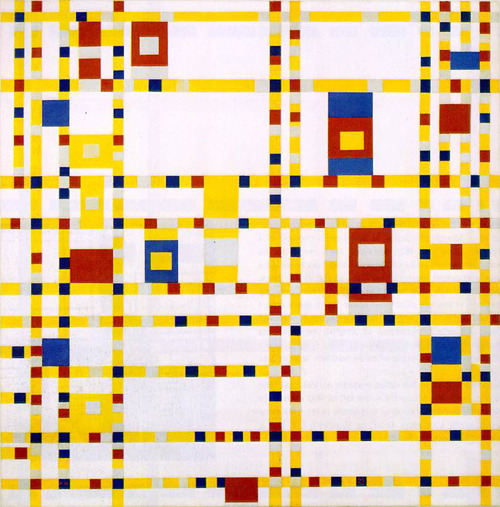
on the cover: Broadway Boogie-Woogie, 1942–43, MoMA, New York
“This is why I say that such things are not beautiful in relation to anything else, like other things, but are always beautiful in themselves, by nature, and yield their own specific pleasures.”
— Plato, Philebus
Try to imagine a painting by Mondrian in any setting, and you will immediately notice how everything around it appears disordered, excessive, superfluous—things you had not paid attention to before. You will become aware of uncertain lighting, confused colors, useless forms; a sensation that easily shifts from the material world to the realm of the spirit.
An uncomfortable presence, like a call of conscience, like a moral warning; yet a salutary presence, because it compels you to reassess values and helps you distinguish the essential amid the confusion of appearances. Only those things that respond to a precise logic of function will conform to that measure—things not born of chance or instinct, but of an intellectual order, revealing the inner balance proper to every authentic work, whether an object of use or of art.
For a painting by Mondrian is balance itself, the result of a rigorous calculation of relationships, of a constant reduction of every particular to the general, of the accidental to the permanent. Such relationships and balances have always been the foundations of beauty; once clothed in natural appearances, Mondrian sought to represent them in themselves, as the common elements of every individual reality.
Throughout his life, Mondrian devoted himself to the search for this truth, with the conviction of an apostle and the dedication of an ascetic. His writings have a moving monotony, circling endlessly around the same theme, striving to clarify the same idea: “life is a continual deepening of the same thing”—his own words.
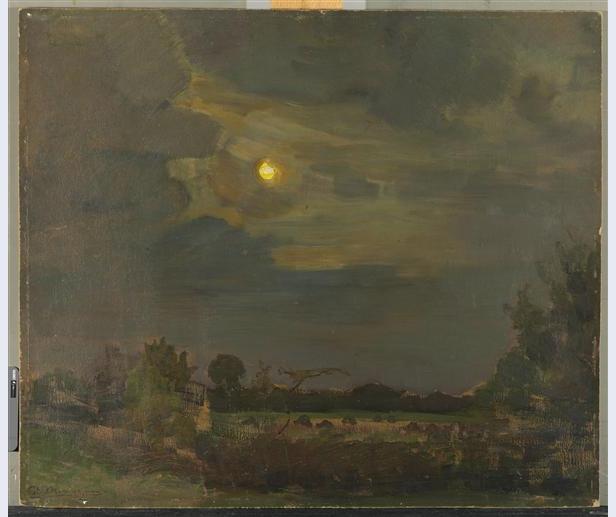
Landscape, 1907, Gemeentemuseum, The Hague
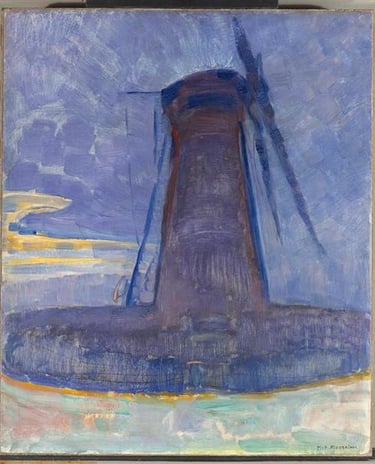
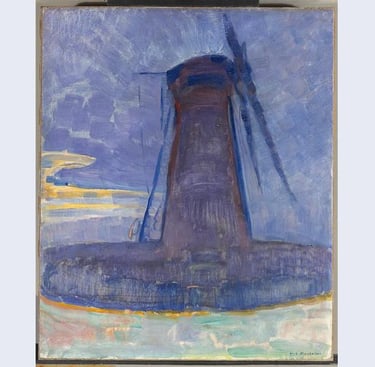
Windmill at Domburg, 1908, Gemeentemuseum, The Hague
Those who think only of the artist’s most famous works—the mature paintings of the period he himself called Neoplastic—may not realize it. But anyone who follows his work from the beginning will see with what coherence his aim is pursued, without deviation, along the thread of an intuition that gradually becomes certainty, with an exclusive fervor akin to religion. One sees a path entirely revealed, marked by absolute sincerity—so evident in its achievements and so scrupulous as to become almost exemplary. A slow maturation, driven entirely by an irresistible inner impulse.
When, at the end of 1911, Mondrian went to Paris for the first time and recognized in Cubism what he had been seeking, he had already conducted experiments on his own that led him toward an increasingly declared abstraction of nature—of which Cubism then appeared as the natural breakthrough.
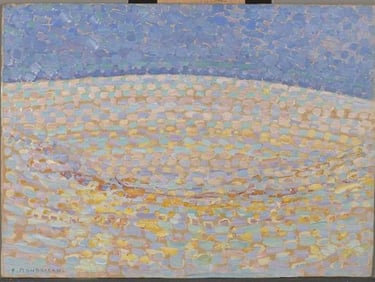
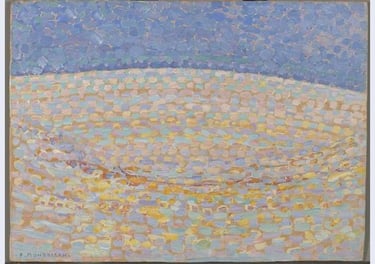
Dune III, 1909, Gemeentemuseum, The Hague
From the very beginning, when he devoted himself mainly to landscape studies in an impressionistic technique, the character of his painting was never instinctive or romantic, nor truly naturalistic. Even then, he did not wish to imitate—or even interpret—nature, but to discover its truest structure, its deep and universal reality, stripped of the contingent.
In this pursuit, he first freed color, which became ever purer, valid in itself as an autonomous language, as in the principles of Fauvist painting; then he sought to free form, which, in striving toward the essential, became almost symbolic.
The encounter with Cubism, at that moment in his evolution, proved decisive. It is fascinating to follow, in that period (1911–1914), the slow and gradual work of transforming the natural object into the abstraction of its lines and colors, uncovering the reality hidden beneath appearances.
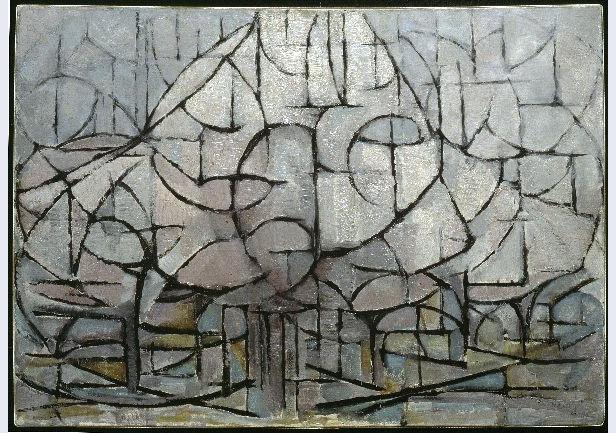
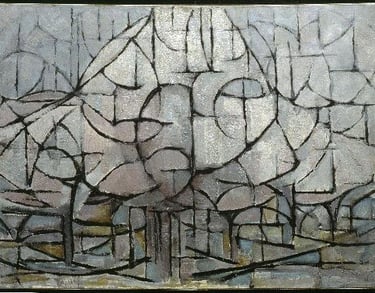
Flowering Trees, 1912, Gemeentemuseum, The Hague
In the series of still lifes with the ginger jar, and even more in the studies of trees, the artist’s thought unfolds with a precision that resembles a classroom demonstration: work by work, step by step, each painting advancing further—pruning, simplifying, with almost obsessive consistency. It is like watching a scientist pursuing an idea day by day, experiment after experiment, until the intuited truth is scientifically proven.
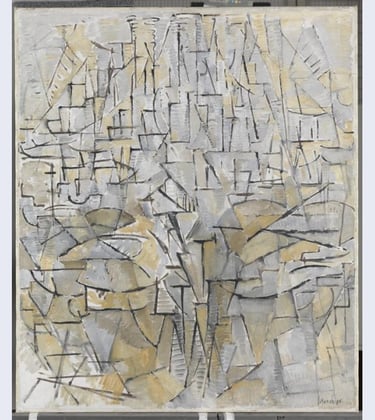
Yet Cubism was still a representation of visible reality, even if broken apart and reconstructed in an attempt to express a synthesis of its many aspects. For Mondrian, this was not enough: he believed Cubism had not pushed its intuitions to their ultimate consequences, stopping short at appearances.
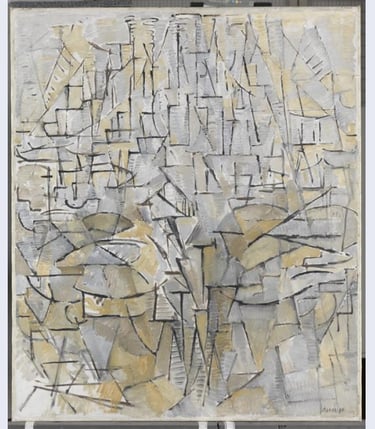
Tableau No. 4, 1913, Gemeentemuseum, The Hague
One had instead to reject all appearance and reach the origins—the primary source of the infinite variations of the sensible world—and represent it plastically only through the equilibrium of pure relationships, the equivalence of opposites, the contained dynamism of right-angled lines, symbols of stability. One had no longer to imitate, but to be line, color, light itself.
In seeking to attain universal reality, abolishing the individual, the instinctive—and therefore the egoistic—Mondrian’s art assumes an ethical and human significance. The suffering and upheavals caused by the World War, the overturning of values that had sustained society until then, certainly reinforced in his reflective spirit a meditation on a dramatic human condition, which he traced to the dominance of subjective feelings and to the deceptive appearances of reality as primary causes of life’s tragedy.
By freeing things from their misleading limits and rediscovering a shared, truer reality, one may also free humanity from the anguish that seems the fatal condition of modern life.
Composition, 1919, Kröller-Müller Museum, Otterlo
Thus Mondrian’s work, far from being cold and detached—as it may appear to those who see only its perfectly calibrated geometric compositions of relentless purity—aims instead to be a message of confidence and, in affirming a possible equilibrium, even of happiness. This great utopian seeks to offer humanity the certainty of order within the chaos of appearances, the primary cause of disorder and unhappiness.
Hence the social value of Mondrian’s art and its natural integration—already forty years ago—into the deep movements of the modern, mechanical, industrialized world, in which technique, number, and quantity have new and dominant functions, yet without ceasing to be human. His principles have spread and been reflected everywhere: in architecture, urban planning, interior design, industrial products, even in advertising and the forms of everyday objects.
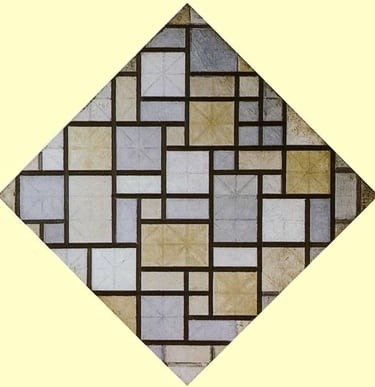
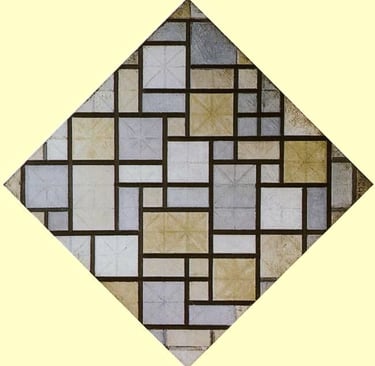
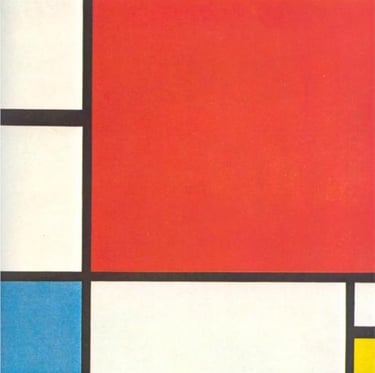
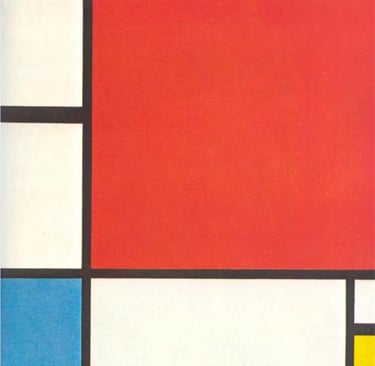
Composition, 1921, GNAM, Rome
Composition, 1921, Gemeentemuseum, The Hague
A painting by Mondrian is the artistic form of that world. Nothing could express with greater purity the rhythm of our life—so often criticized in the name of a past way of life that we can now feel only as history. This present time has its own beauty and value, which artists, as always, have been the first to reveal.
Therefore, a Mondrian painting is not something to contemplate from afar, alien and superhuman, but something to use, to integrate into one’s life—an aid to understanding oneself and the surrounding world. And like an object, it is executed with careful, almost artisanal labor.
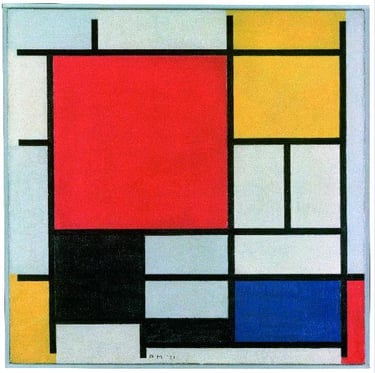
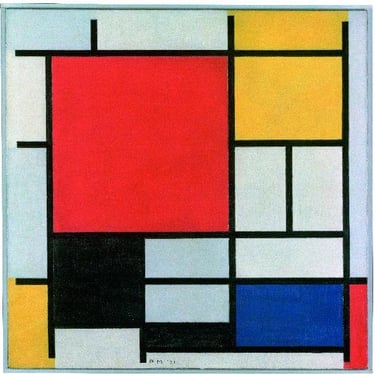
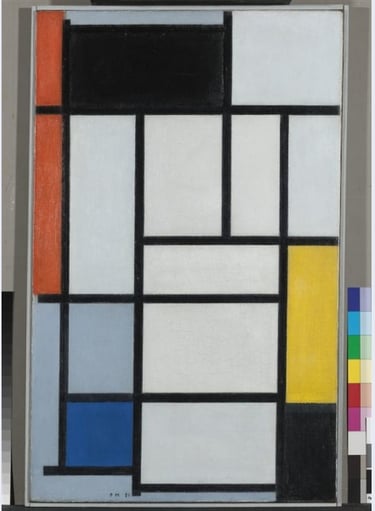
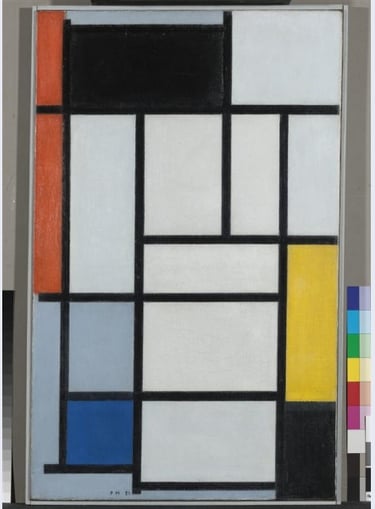
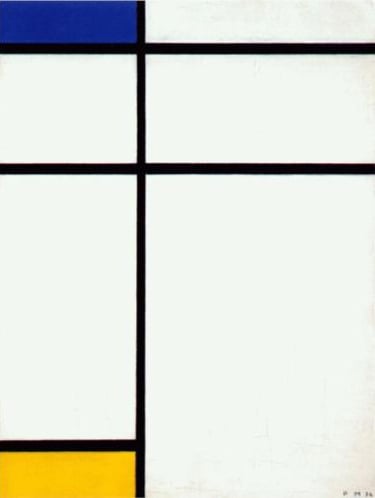
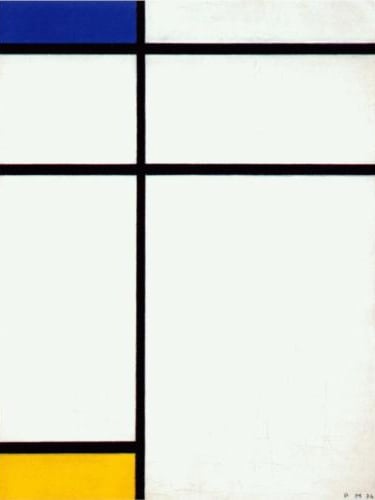
It seems so simple: a white or gray background, black lines, squares and rectangles of pure primary colors—red, yellow, blue. And yet, even from a purely technical perspective, one sees how everything is painted with infinite care; every brushstroke has its value, thickness, intensity, in subtle luminous variations; every effect is minutely calculated—not with cold geometry, but with the acute sensitivity of a painter.
For this reason, Mondrian’s paintings are not as numerous as one might think: their execution always required not only a long conceptual maturation, but also an extremely long time to complete.
Composition, 1930, private collection
One of the most perfect relationships in modern culture was thus established between this artist and contemporary life. He deeply understood and loved it, sensitive to its social, moral, and material demands—as shown, among other things, by his interest in the form of the house, both as architecture and as interior space; attentive and responsive to every novelty, as demonstrated by his appreciation of American life, its hyperbolic cities, the perfection of its mechanical organization, even the broken, multicolored rhythm of jazz.
It is for this engagement with the problems of our life—not only for the universality of all true art—that Italians too feel this artist as vivid and present. Italian artists understood his message; architects, painters, sculptors all benefited from it, especially in terms of clarity and order.
A certain tendency in Italy to overemphasize instinct, emotion, passion—which often lead, in art as in life, to the casual, the disordered, the arbitrary—finds in Mondrian a salutary corrective in the direction of intelligence, reason, and culture. The inclination toward individualism, egoism, social isolation finds a counterweight in the collective spirit, in the universal direction of Mondrian’s art.
Even a certain indulgence in the picturesque finds restraint in a classical measure. And this too brings Mondrian close to our spirit: perhaps no other artist has achieved such a pure and lucid expression of classical composure. In his mathematical calculations, in his geometric compositions, we find the modern aspect of those concepts that informed the highest works of our Renaissance.
Composition III, 1936, Kunstmuseum, Basel
It is therefore not accurate to say that Mondrian is exclusively northern or Dutch, merely because his sense of abstraction appears so rigorous and pure, a puritanism pushed toward mysticism. That element is certainly present, as every artist bears the imprint of their land; but it is transcended by his capacity to extract from particulars a common value, the image of a reality ordered according to a universal measure.
He himself said that the new art was imbued with Latin culture, expressing both the reflective spirit of the North and the clarity of the South. Thus, for us too, it is impossible to think of our time without Mondrian, or Mondrian without our time.
We feel him as an essential part of our way of being and living. A Mondrian painting harmonizes naturally with everything we perceive as alive around us, while pushing away all that is dead—expressions of a time not our own, of a way of life that no longer belongs to us.
For those who can understand it, a Mondrian painting is not only a work of art, but a philosophical principle and a rule for living—a measure by which to know what matters and what no longer does.
Palma Bucarelli
originl version in Italian here
© 2025. All rights reserved.
Contacts
Or WhatsApp me: